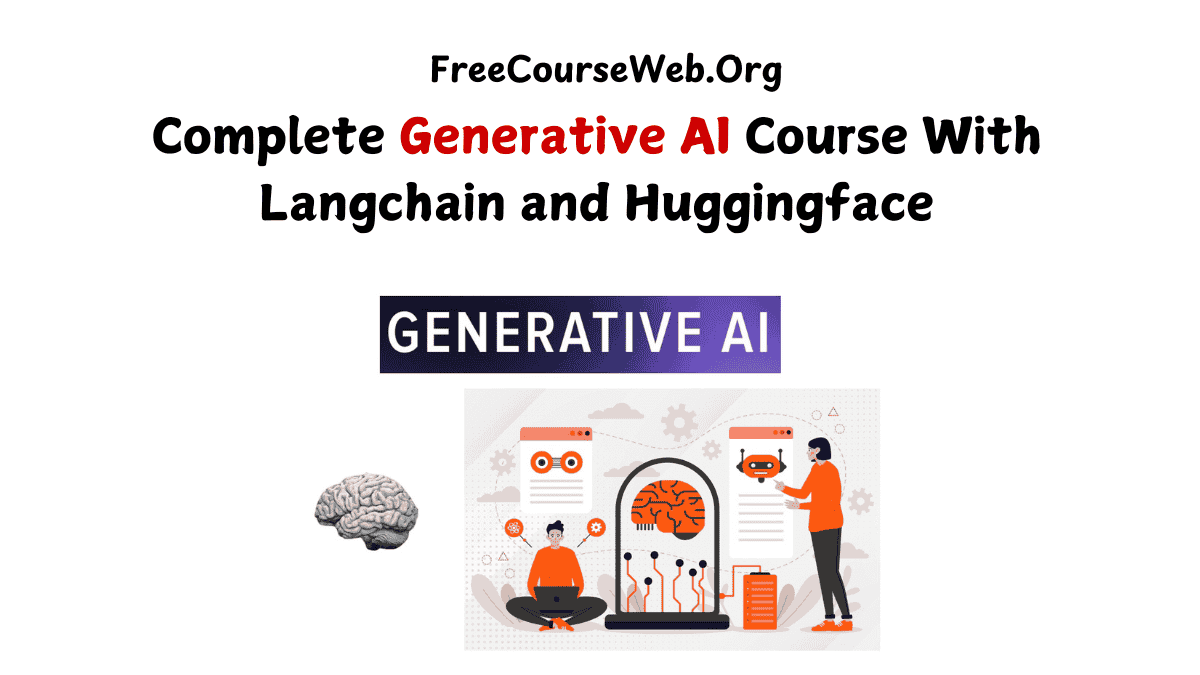
Complete Generative AI This comprehensive course is designed to equip learners with the skills to build, deploy, and optimize generative AI applications using the LangChain framework and Huggingface’s state-of-the-art models.
Through hands-on projects, step-by-step tutorials, and real-world applications, participants will master the fundamentals of generative AI, understand advanced architectures, and develop scalable AI solutions.
Perfect for AI enthusiasts, developers, and professionals aiming to leverage generative AI in domains like chatbots, content generation, and data augmentation.
MailChimp Email Marketing Course For Beginners
Free SEO Training with Free Video Course
Course Objectives
- Understand the fundamentals of generative AI and its distinction from traditional AI models.
- Master the LangChain framework for building AI-driven applications.
- Leverage Huggingface’s pre-trained models for natural language processing (NLP) tasks.
- Develop and deploy Retrieval-Augmented Generation (RAG) pipelines.
- Gain hands-on experience through real-world projects like chatbots and content generators.
- Learn deployment strategies for cloud and on-premise environments.
- Fine-tune and customize Huggingface models for specific use cases.
1. What is Generative AI?
Generative AI is a type of artificial intelligence that can create new content based on the information it has learned from large amounts of data. It can generate text, images, audio, video, code, and other types of content. Generative AI is becoming an important technology in many areas, from education and business to software development and content creation.
A. Definition and Scope of AI, Machine Learning, and Generative AI:
Artificial Intelligence (AI) is a broad field focused on creating systems that can perform tasks that normally require human intelligence. Machine learning (ML) is a part of AI that allows computers to learn patterns from data and improve their performance. Generative AI is a specialized area that uses learned patterns to create new content.
B. Traditional AI vs. Generative AI:
Traditional AI is often designed to analyze information, recognize patterns, make predictions, or classify data. Generative AI goes a step further by producing new content based on a user’s instructions or input.
C. Real-World Applications:
Generative AI is used in chatbots, content creation, image generation, coding assistants, and data augmentation. For example, AI chatbots can answer questions, while content-generation tools can help create articles, ideas, or marketing materials. These applications can save time and support people in their daily work.
2. Overview of Large Language Models (LLMs)
Large Language Models (LLMs) are advanced AI models designed to understand and generate human-like text. They are trained on large amounts of text data, which helps them learn language patterns, meanings, and relationships between words. LLMs can be used for tasks such as answering questions, writing content, summarizing information, translating languages, and helping with coding.
A. Introduction to LLMs:
Popular language models include GPT, Llama, and BERT. GPT models are widely used for generating and understanding text. Llama is a family of large language models designed for a range of AI applications. BERT is mainly known for understanding the context and meaning of words in text and is commonly used for language-related tasks.
B.Role of Transformers in Generative AI:
Transformers are an important technology behind many modern language models. They help AI understand the relationship between words and their surrounding context. Unlike older methods that processed text mainly one part at a time, transformers can process many parts of a sentence efficiently and identify which words are important to each other.
3. Setting Up the Development Environment
Before starting with AI, machine learning, or data-related projects, it is important to set up a proper development environment. A good environment provides the tools needed to write code, work with data, test programs, and build projects more easily. Beginners can start with a few essential software tools and add more as they progress.
A. Installing Python, Anaconda, and Essential Libraries:
Python is one of the most commonly used programming languages for AI, machine learning, and data analysis. After installing Python, you can install useful libraries such as NumPy and Pandas. NumPy is helpful for working with numbers and arrays, while Pandas makes it easier to organize, analyze, and manage data. Anaconda is another popular option because it provides Python along with many useful tools and libraries in one package.
B. Introduction to Jupyter Notebooks and IDEs:
Jupyter Notebook provides an interactive environment where you can write and run Python code step by step. It is especially useful for learning, data analysis, and experimenting with AI projects.
You can also use an IDE (Integrated Development Environment) such as PyCharm or VSCode. These tools provide features like code editing, debugging, file management, and extensions that make programming easier.
4. Hands-On: First Steps with Python for AI
Python is one of the most useful programming languages for AI and machine learning. In this section, you will take your first practical steps with Python and learn how it can be used to work with data and build simple AI applications. The focus is on basic coding and hands-on practice, so beginners can understand the concepts more easily.
A. Writing Basic Python Scripts for Data Manipulation:
You will learn how to write simple Python programs for working with data. This includes storing information in variables, working with lists and other data structures, and performing basic operations on data. These skills provide a strong foundation for future AI and machine learning projects.
B. Exploring NLTK and SpaCy for NLP:
You will also get an introduction to libraries such as NLTK and SpaCy, which are commonly used for Natural Language Processing (NLP). You can use these tools to work with text, understand words and sentences, and perform basic language-processing tasks.
C. Project: Build a Simple Text Generator:
As a practical project, you will create a basic text generator using a pre-trained model from Hugging Face. This project will help you understand how existing AI models can be used in Python to generate text and give you practical experience with generative AI.
Module 2: Mastering LangChain
Duration: 8 hours
Objective: Learn the LangChain framework and its role in AI application development.
Lessons:
Introduction to LangChain
Overview of LangChain and its ecosystem (Chains, Agents, DocumentLoader, TextSplitter).
Understanding LangChain Expression Language (LCEL).
Building Chains and Agents
Creating prompt chains for structured AI interactions.
Implementing LangChain agents for dynamic decision-making.
Memory and Context in LangChain
Adding memory to AI applications for contextual awareness.
Managing conversation history in chatbots.
Hands-On: LangChain Basics
Setting up a LangChain environment (LangChain v0.3.0).
Building a simple Q&A system using LangChain.
Project: Develop a LangChain-based chatbot that maintains conversation context.
Module 3: Huggingface and Transformers
Duration: 10 hours
Objective: Master Huggingface’s Transformers library for NLP tasks.
Lessons:
Introduction to Huggingface
Overview of Huggingface ecosystem and pre-trained models.
Using the pipeline() function for text generation, classification, and more.
Understanding Transformers
Encoder, decoder, and encoder-decoder architectures.
Use cases for Transformers in generative AI.
Fine-Tuning Huggingface Models
Techniques for fine-tuning models (e.g., Instruction Fine-tuning, PEFT).
Customizing models for specific domains (e.g., sentiment analysis, summarization).
Hands-On: Huggingface in Action
Implementing text generation with GPT-2.
Performing sentiment analysis using BERT.
Project: Fine-tune a Huggingface model for a custom text summarization task.
Module 4: Retrieval-Augmented Generation (RAG)
Duration: 8 hours
Objective: Develop RAG pipelines to enhance generative AI performance.
Lessons:
Introduction to RAG
Combining generative models with retrieval systems.
Role of vector databases (e.g., Pinecone, FAISS).
Building RAG Pipelines
Creating embeddings for text data.
Integrating vector stores with LangChain.
Optimizing RAG Systems
Improving accuracy and performance of RAG pipelines.
Handling large-scale datasets for retrieval.
Hands-On: RAG Implementation
Building a knowledge retrieval assistant using LangChain and FAISS.
Project: Create a RAG-based question-answering system for a specific domain (e.g., Wikipedia data).
Module 5: Deployment and Optimization
Duration: 10 hours
Objective: Learn to deploy and optimize generative AI models.
Lessons:
Deployment Strategies
Deploying models to cloud platforms (e.g., AWS, Azure).
Setting up on-premise servers for AI applications.
Scalability and Reliability
Ensuring high availability and low latency.
Load balancing and auto-scaling techniques.
Monitoring and Optimization
Techniques for monitoring deployed models.
Best practices for model updates and maintenance.
Hands-On: Model Deployment
Deploying a LangChain-Huggingface application to a cloud platform.
Project: Deploy a generative AI chatbot to a cloud server with monitoring capabilities.
Module 6: Real-World Projects
Duration: 12 hours
Objective: Apply learned concepts to build portfolio-ready projects.
Projects:
Chatbot for Customer Support
Build an AI-powered chatbot using LangChain and Huggingface.
Implement memory and RAG for contextual responses.
Content Generation Tool
Create a tool for generating blog posts or social media content.
Fine-tune a Huggingface model for specific content styles.
Data Augmentation System
Develop a system for generating synthetic data for machine learning tasks.
Use RAG to enhance data quality.
Text-to-Image Generator
Integrate Huggingface’s Diffusers library with LangChain for multimodal AI.
Create a tool for generating images from text prompts.
Module 7: Capstone Project
Duration: 2 hours
Objective: Synthesize all skills in a comprehensive project.
Capstone Project: Build a full-stack generative AI application (e.g., a knowledge management system) that integrates LangChain, Huggingface, RAG, and cloud deployment. The project includes:
- A front-end interface using Streamlit or Gradio.
- A back-end with FastAPI or Flask.
- A vector database for RAG.
- Monitoring and optimization features.
Course Features
- Hands-On Learning: 50+ hours of video content, coding exercises, and projects.
- Real-World Projects: Build portfolio-ready applications in chatbots, content generation, and more.
- Community Support: Access to a dedicated forum for peer and instructor interaction.
- Certificate of Completion: Earn a certificate to showcase your skills.
- Lifetime Access: Revisit course materials anytime.
Target Audience
- AI enthusiasts eager to explore generative AI.
- Developers looking to integrate AI into their applications.
- Professionals aiming to build and deploy scalable AI solutions.
- Students and researchers interested in NLP and generative models.
Learning Outcomes
By the end of this course, you will:
- Build advanced generative AI applications using LangChain and Huggingface.
- Understand and implement RAG pipelines for enhanced AI performance.
- Fine-tune and deploy Huggingface models for custom use cases.
- Develop scalable, production-ready AI applications.
- Gain hands-on experience with real-world projects in multiple domains.
Resources
- Code Repository: Access all project code on GitHub.
- Supplementary Materials: Downloadable datasets, notebooks, and templates.
- Recommended Tools: Python, Anaconda, Jupyter, LangChain (v0.3.0), Huggingface Transformers, Diffusers, Gradio, Pinecone, FAISS.
Enrollment Details
- Platform: Udemy
- Link: Complete Generative AI Course with LangChain and Huggingface
- Discount: Check for current promotions (e.g., $9 for first 1,000 enrollments or 30 days).
- Access: Lifetime access to course materials and updates.
About the Instructor
Krish Naik is the ex-co-founder and Chief AI Engineer of iNeuron, with over 15 years of experience in machine learning, deep learning, and generative AI. As an educator and mentor, Krish has trained thousands of students through Krish AI Technologies, focusing on practical, industry-relevant AI skills.
Join this exciting journey to master generative AI and build cutting-edge applications with LangChain and Huggingface!