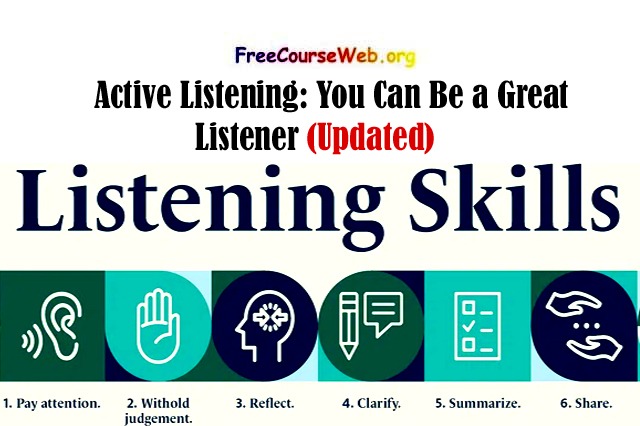
Active Listening Enhance your responsiveness, cultivate a purposeful listening mindset, magnify your curiosity, and contribute value as an exceptional listener.
Active Listening
Cross Cultural Communication: How To Flex Your Style
Design Thinking For Beginners: Develop Innovative Ideas
How to Start a Successful Blog
| Learning Objectives | Description |
|---|---|
| Identify & overcome common habits of reacting | Recognize and address habitual reactions that hinder effective listening. |
| Shift attention from your own thoughts to the speaker | Redirect focus from internal thoughts to the speaker’s message, acknowledging their importance. |
| Develop & practice observing the speaker’s words | Cultivate the skill of observing both verbal and non-verbal cues to better understand the message. |
| Use simple “starter” phrases to reflect back | Employ basic phrases to reflect the speaker’s message, building trust and confirming active listening. |
| Improve ability to notice a speaker’s emotions | Enhance the capability to perceive and empathize with the speaker’s emotions for better understanding. |
| Unleash natural curiosity with powerful questions | Engage curiosity by asking insightful questions that promote clarity, add value, and strengthen connections. |
Here’s a table summarizing the requirements for the course:
| Requirements | Details |
|---|---|
| Prerequisite | Desire to become a great listener |
| Accreditation | NASBA CPE accredited course |
| Accrediting Body | National Association of State Boards of Accountancy (NASBA) |
| NASBA CPE Credits | 4.2 credits |
| Recommended Field of Study | Communications & Marketing – Non-Technical |
| Program Level | Basic |
| Earn NASBA CPE Credits | – Complete all videos |
| – Achieve a score of 70% or higher on the final exam | |
| Glossary | Find PDF attached to the first lecture of this course |
| Completion Deadline | CPE completion should be achieved within a year after the purchase date |
| Course Description and Learning Objectives | Details |
|---|---|
| Course Focus | Active Listening as a powerful tool for influencing, leading, collaborating, and personal development. |
| Instructor | Professional listener and Master Certified Coach with 20 years of experience. |
| Course Benefits | Gain internal awareness and external skills for more satisfying and successful conversations. |
| Course Structure | Practical Udemy course with real-world examples to demystify and simplify Active Listening skills. |
| Unique Insights | Instructor’s personal journey from a terrible listener to a professional listener. |
| Interactivity | Participants encouraged to interrupt, have short conversations, and not provide answers or expertise. |
| Target Audience | People looking to reduce frustration, improve collaboration, and manage successful interactions. |
| CPE Credits | Continuing Professional Education (CPE) credits offered. |
Learning Objectives:
| Learning Objectives | Details |
|---|---|
| Define Active Listening | Clearly understand the concept and importance of active listening. |
| Distinguish between Level 1 and Level 2 listening | Differentiate between passive listening and actively engaged listening. |
| Describe the mindset behind active listening | Understand the mental approach necessary for effective active listening. |
| Explain behaviors leading to active listening | Identify and adopt behaviors that contribute to active listening. |
| Recognize non-verbal cues during communication | Learn to interpret non-verbal cues for additional insights while communicating. |
| Describe the importance of reflecting back and ways to do so | Understand the significance of reflecting back and various methods to implement it. |
| Identify 5 Powerful Questions for deeper listening | Learn powerful questions that enhance the depth of understanding in conversations. |